

Phnom Penh, Tuesday, 16 June 2026
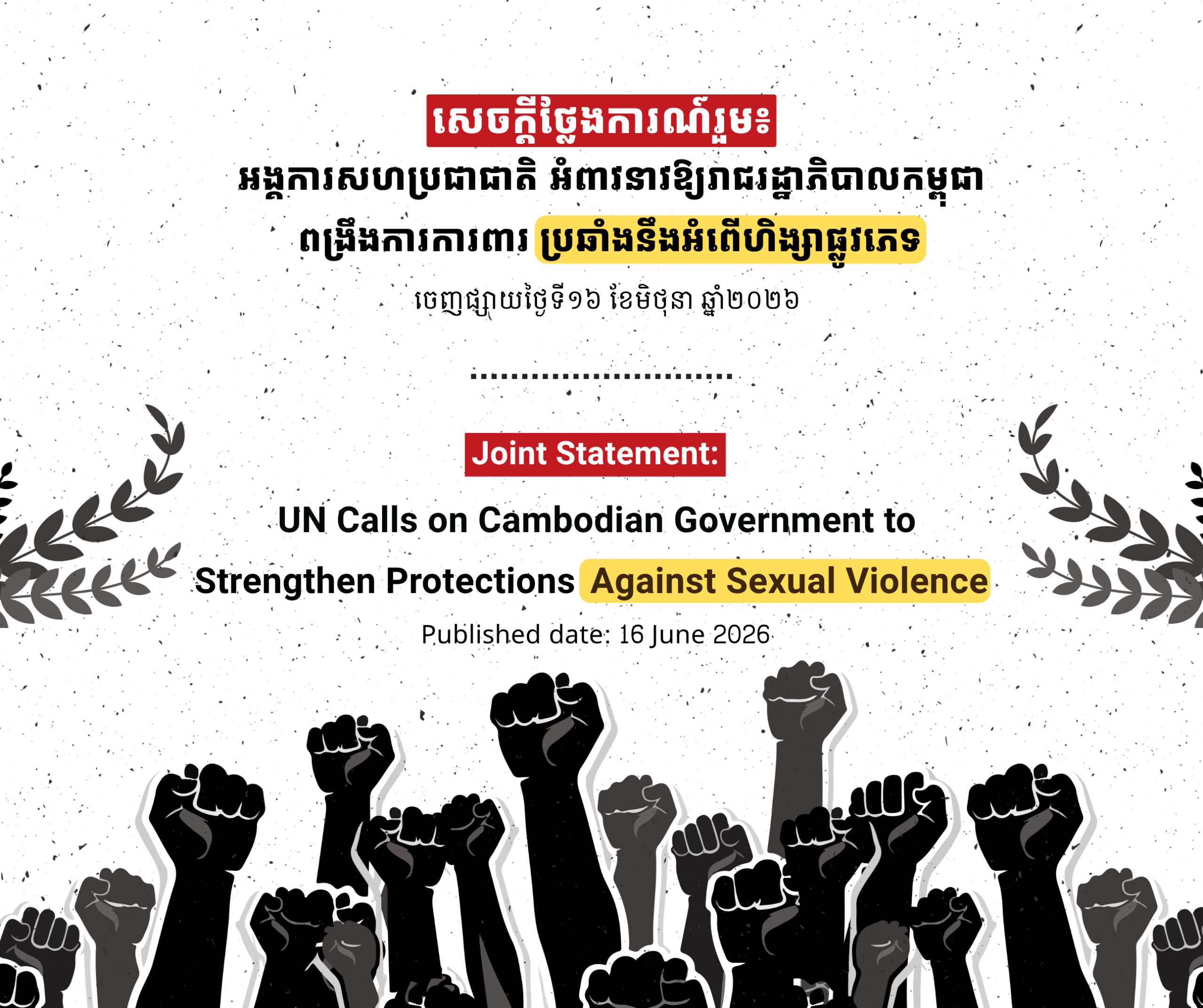
For the first time, the UN Committee on the Elimination of Discrimination against Women (CEDAW Committee) has issued a decision in an individual case concerning Cambodia, finding that the Cambodian government violated the rights of a young Cambodian girl who was repeatedly raped by a police officer. The Committee found that the Cambodian government failed to ensure justice, protection, and effective remedies, and instead perpetuated impunity and discrimination which “exposed her to ongoing harassment and intimidation, causing irreparable psychological harm and revictimizing her”.
We welcome the landmark views adopted by the Committee and call on the government to immediately increase efforts to prevent gender-based violence and ensure that every victim/survivor has access to fair and timely justice that is free from discrimination.
As a party to the Optional Protocol to the Convention on the Elimination of all Forms of Discrimination against Women, Cambodia recognises the CEDAW Committee’s competence in receiving and considering complaints about individual cases that happen in Cambodia.
The case submitted to the Committee concerns a police officer who repeatedly raped an 11-year-old girl with a disability in 2010. Despite eventual conviction by the Supreme Court in 2016, the perpetrator has not served the prison sentence or paid the civil compensation owed. The Committee found that the legal process was marked by extensive delays, inadequate sentencing, and a failure to enforce the final judgment. The girl and her family have now been waiting for justice for 16 years while the perpetrator remains at large.
The CEDAW Committee concluded that Cambodia violated its obligations by failing to provide effective protection and remedy, perpetuating impunity and discrimination. This included:
-
Failing to ensure a prompt, independent, impartial, and thorough investigation
-
Applying discriminatory stereotypes related to gender, age, and disability
-
Applying stereotypical understandings of sexual violence and unreasonable evidentiary standards
-
Imposing an inadequate sentence that did not reflect the severity of the violation
-
Failing to enforce the final judgment, including arrest and payment of compensation
-
Failing to implement protections throughout the legal process, resulting in deprivation of her right to liberty, freedom of movement, and association
The Committee identified that these were “tantamount to a failure of justice” and “a denial of effective justice”. These views, adopted on 20 February 2026, reflect the systemic barriers to justice and safety faced by victims/survivors of gender-based violence and people with disabilities in Cambodia.
We now urge the Cambodian government to take immediate and concrete action to implement the Committee’s recommendations. Among others, these recommendations include:
-
Immediately enforcing the Supreme Court judgment, including the arrest and detention of the perpetrator and full payment of civil compensation
-
Providing the girl and her family with reparative justice, restitution for financial damages, psychological support, and measures to restore dignity and community inclusion
-
Revising the legal framework to ensure it reflects international standards regarding consent, strictly enforcing prescribed penalties, and ending unfair evidentiary standards
-
Prohibiting the use of non-judicial resolutions – including reconciliation, mediation, and other alternative dispute resolution mechanisms – in sexual violence cases
-
Ensuring effective, gender-sensitive, victim/survivor-centred, trauma-informed, child-friendly, and non-discriminatory access to justice in all sexual violence cases
The Committee requested Cambodia provide information regarding the complaint on three occasions prior to issuing these views. Cambodia failed to engage with the Committee or provide any information or observations. Cambodia now has six months to provide a written response to the Committee, including information on any action taken in the light of the views and recommendations. The Committee also requested that Cambodia translate its findings to Khmer and disseminate them widely. We will continue to monitor the government’s implementation of these recommendations in the coming months.
The case marks the first views concerning Cambodia issued under the Optional Protocol to the CEDAW Convention. Cambodia now has an opportunity to clearly demonstrate that sexual violence and discrimination are intolerable acts that it is urgently working to end. We urge the Cambodian government to implement the recommendations, publicly report on its progress, and ensure effective justice for every Cambodian who has experienced sexual violence.
This joint statement is endorsed by:
-
197 Land Community (Koh Kong)
-
Andong Trabek Land Community (Svay Rieng)
-
Amleang Land Community (Kampong Speu)
-
Association of Domestic Workers (ADW)
-
Association to Support Vulnerable Women (ASVW)
-
Boeung Pi Community (Battambang)
-
Boeung Pram Community (Battambang)
-
Bos Snor Communiy (Tboung Khmum)
-
Cambodian Health and Education for Community (CHEC)
-
Cambodian Labour Confederation (CLC)
-
Cambodian League for the Promotion and Defense of Human Rights (LICADHO)
-
Cambodian Organization for Women Support (COWS)
-
Center for Alliance of Labor and Human Rights (CENTRAL)
-
Chi Kha Kraom Community (Koh Kong)
-
Community Council for Development Organization (CCDO)
-
Committee for Free and Fair Elections in Cambodia (COMFREL)
-
Community to Protect Nature (Pursat)
-
Dak Por Community (Kampong Speu)
-
Environment and Health Education Organization (EHE)
-
Equitable Cambodia (EC)
-
Gender and Development for Cambodia (GADC)
-
Klahaan Organisation (KLAHAAN)
-
Klaing Toek 78 Community (Siem Reap)
-
Kuy Indigenous Community in Boh village (Preah Vihear)
-
Kuy Indigenous Community in Ngan Commune (Kampong Thom)
-
Kuy Indigenous Community (Preah Vihear)
-
Land Community (Pailin)
-
Lor Peang Community (Kampong Chhnang)
-
Mondulkiri Indigenous People’s Association for Development (MIPAD)
-
Mean Chey Land Community (Svay Rieng)
-
Nature Protection Oudom Sre Pors Community (Kampong Speu)
-
Ou Bat Moan Community (Oddar Meanchey)
-
Phnom Krom Community (Siem Reap)
-
Phnom Srey Organization for Development (PSOD)
-
Pongrok Chey Leak community (Kampot)
-
Prey Chher Pech Changvar Laor Chhert Community (Kampong Chhnang)
-
Prey Lang Community (Kampong Thom)
-
Prey Lang Community (Kratie)
-
Prey Lang Community (Stung Treng)
-
Phum Seila Khmer Land Community (Banteay Meanchey)
-
Rattanak Rokha Forestry Community (Oddar Meanchey)
-
Reaksmei Sameakki Community (Kampong Speu)
-
Rural Aid Organization (RAO)
-
Samaki Chek Meas Community (Svay Rieng)
-
Samaki Romeas Haek Community (Svay Rieng)
-
Samaki Sangkae Pir Mean Rith (Preah Vihear)
-
Samakum Krom Akphiwat Phum (KAWP)
-
Sahmakum Teang Tnaut Organisation (STT)
-
Srae Prang Land Community (Tboung Khmum)
-
Sre Ampel Water Fall Tourism Forestry Community (Kampong Chhnang)
-
Stueng Khsach Sa Forestry Resource (Kampong Chhnang)
-
Ta Ni Land Community (Siem Reap)
-
The Cambodian NGO Committee on CEDAW (NGO-CEDAW)
-
The Cambodian Women’s Development Association (CWDA)
-
Thnaot Chum Land Community (Pursat)
-
Tonlung Community (Tboung Khmum)
-
Trapeang Chan Forestry Community (Kampong Chhnang)
-
Trapeang Chour Community (Kampong Speu)
-
Women Peace Makers (WPM)
- Cambodian Youth Network (CYN)
PDF: Download full full statement in English, Download full full statement in Khmer