

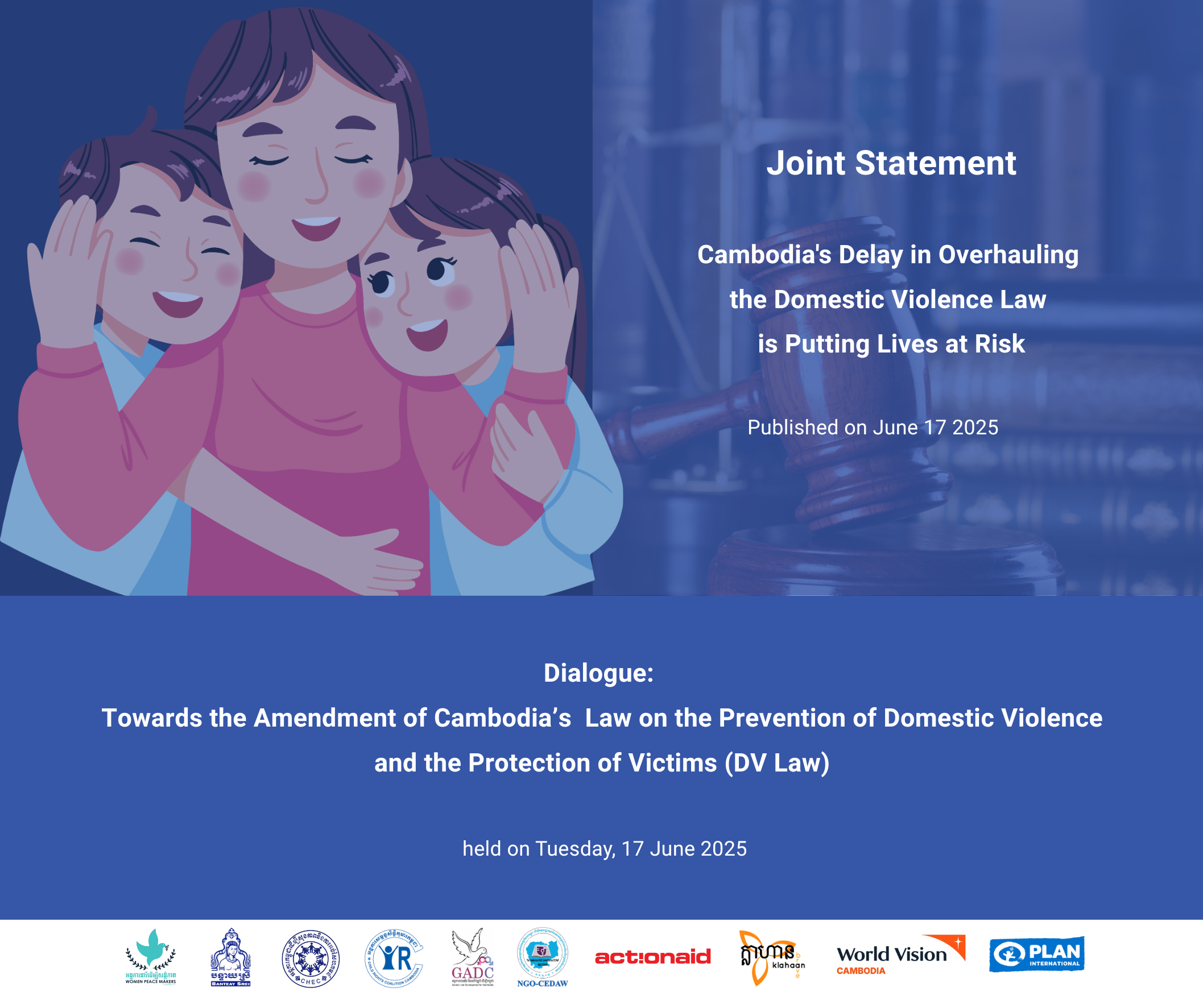
Published: 17 June 2025
For more than eight years, there has not been significant progress in amending Cambodia’s 2005 Law on the Prevention of Domestic Violence and the Protection of Victims. This is a concern given that government surveys continue to show overwhelming levels of violence and abuse — which most often affects women, LGBTIQ+ people, and children.
The government’s Cambodia Demographic and Health Survey of 2021-2022 (CDHS) found that one in five women (21%) who had ever been partnered had experienced emotional, physical, and/or sexual violence by their current or most recent partner. Three-quarters of those who had experienced violence (75.8%) reported being fearful most of the time, with nearly all perpetrators (90.2%) using five or more controlling behaviours.
These numbers reflect an often-deadly reality. In 2024, the Cambodian League for the Promotion and Defense of Human Rights (LICADHO) investigated 139 domestic violence cases perpetrated by current or former intimate partners, family members, or other people living in the same household, against adult women and/or children. Twenty-three people were killed across these cases. This tragedy cannot be allowed to continue.
From 2020 to 2024, Banteay Srei Organization similarly provided essential services in a total of 342 domestic violence cases in Battambang and Siem Reap provinces. Barriers to justice stemming in part from the current Domestic Violence Law — as well as gaps in access to essential services provided by the government — were apparent across these cases.
Amending the law is an essential step towards addressing this crisis. Domestic violence in Cambodia is fuelled by gender inequality and gender stereotypes, and sustained by ineffective interventions by authorities and a lack of societal support. The application of a survivor-centred approach is significantly limited, particularly in addressing cases involving children, women, and marginalised groups. Support services are limited and often not tailored to the needs and safety of survivors, resulting in barriers to reporting and recovery.
Authorities often first attempt to “educate” perpetrators and reconcile couples despite ongoing risks. Many women have reported negative experiences with these practices, which routinely fail to end the violence. These ineffective interventions at times result in people facing backlash or escalating violence by perpetrators.
Many of these challenges are underpinned and perpetuated by the Domestic Violence Law as it currently stands. The law’s inadequacies have been analysed and highlighted by civil society organizations, government actors, international partners, and UN experts for over a decade. The UN Committee on the Elimination of Discrimination against Women (CEDAW) called for the law’s amendment almost six years ago.
The law’s key and severe weaknesses include:
● A failure to comprehensively include all people at risk of domestic violence within the scope of the law.
● A failure to define, criminalise, and outline penalties for physical, sexual, emotional/psychological, and economic abuse, which leaves the law open to subjective interpretation and enables impunity.
● Implicit endorsement of violence as a means of “disciplining” spouses, children, and dependents (Article 8), an entitlement also granted to parents in the Civil Code (Article 1045).
● Tolerance of “minor” acts of violence; the law outlines that felonies and “severe” misdemeanours should be subject to criminal proceedings (Article 18), yet there is no definition of a “severe” misdemeanour in Cambodian law, allowing authorities not to prosecute domestic violence they perceive as “minor”.
● Encouragement of education, reconciliation, and mediation in cases involving emotional/psychological violence, economic violence, and “minor” criminal domestic violence cases (Articles 13, 17, 26-27). Alternative dispute resolution should be prohibited as a response to all acts of criminal domestic violence.
● A failure to comprehensively define the specific obligations of various authorities to prevent and respond to domestic violence.
● A failure to sufficiently define detailed procedures and protections that must be granted under protection orders and administrative decisions.
● A failure to mandate specific funding from the National Budget for the law’s implementation, prevention efforts, and support services.
Authorities, families, and communities often pressure people facing violence to prioritise traditional family structures over the safety and well-being of people at risk of violence. Many assert that children are better off living in violent homes — despite risks of physical and emotional harm and developmental impacts — than with separated parents. Many people are also financially dependent on their perpetrators, unable to afford legal proceedings or to live without a second income.
The limited scope of the current legal framework in defining abuse contributes to the harms of psychological, emotional, and digital abuse being overlooked and further undermines timely identification and intervention.
It is within the government’s control and commitments to ensure that essential protections and gender-responsive services adequately meet the needs of people facing domestic violence. Yet, the protection and response systems in place remain inadequate — both in terms of reach and capacity. Many communities lack trained personnel, resources, and coordination mechanisms necessary for effective prevention, protection, and support, leaving many people without the help they urgently need. Protection orders and administrative decisions remain systemically underutilised by authorities and the courts. Legal aid, safe shelters, financial aid, and psychosocial support are limited, unresponsive, and lack gender sensitivity, even though some efforts have been made recently.
In this context, most people facing violence have no choice but to remain in dangerous homes and relationships. Even after imprisonment, divorce, or separation, many perpetrators continue or escalate their abuse, with limited effective judicial sanctions and mechanisms to prevent and protect against further violence.
The Cambodian government has agreed that amending the law is necessary. Cambodia’s second National Action Plan on the Prevention of Violence against Women (NAPVAW II) (2014-2018) included a commitment to review and update some articles. This was echoed in the National Action Plan to Prevent and Respond to Violence Against Children (2017-2021). NAPVAW III (2019-2023) again included a commitment to review the law and develop a strategy for its amendment. In 2023, the government developed a roadmap to amend the law, but it has not been made public.
The path forward is clear. There are shortcomings in nearly every article of the Domestic Violence Law. We request that the Cambodian government rapidly moves ahead with amending the Domestic Violence Law to ensure that every person can live free from violence. Every day of delay further normalises all acts of violence, and puts lives at risk.
We call on the Cambodian government to:
● Urgently publicise the roadmap on amending the Domestic Violence Law;
● Draft a revised law which complies with Cambodia’s national and international obligations as soon as possible, through meaningful, transparent and inclusive processes which are grounded in a survivor-centred and child and gender-sensitive approach. Ongoing consultations should be conducted widely with civil society, other relevant stakeholders, child rights actors, and people who have experienced domestic violence; and
● Adopt the fully revised law, backed by the resources required for its unhindered implementation and regular monitoring and evaluation.
—
This joint statement is endorsed by:
1. Banteay Srey
2. ActionAid
3. The Cambodian NGO Committee on CEDAW (NGO-CEDAW)
4. Child Rights Coalition Cambodia (CRC-Cambodia)
5. Gender and Development for Cambodia (GADC)
6. Klahaan Organization
7. World Vision Cambodia
8. Cambodian Health and Education for Community (CHEC)
9. Women Peace Makers (WPM)
10. Plan International Cambodia
11. Save the Children
12. Cambodian Women’s Crisis Center (CWCC)
13. Cambodian League for the Promotion and Defense of Human Rights (LICADHO)
For more information, please contact:
▪ Mao Map, Executive Director, Klahaan Organization, Tel: +855.78.974.040
▪ Oy Mariny, Program Officer, Women Peace Makers (WPM), Tel: +855.86.860.433
▪ But Lim, Senior Program Officer, Cambodian Health and Education for Community (CHEC),Tel: +855.12.308.839
▪ Pech Sopheak, Cambodian Men Network Officer, Gender and Development for Cambodia (GADC), Tel: +855.77.983.414
PDF: Download full statement in English – Download full statement in Khmer