

This report was developed by the Cambodian NGO Committee on CEDAW (NGO-CEDAW) in collaboration with its civil society members and partners, as well as other Cambodian civil society allies who generously provided inputs and technical advice.
The 2025 CEDAW Monitoring Report for Cambodia highlights key concerns, events and new research on the rights of women, girls, and non- binary people from the year. It does not address all issues but rather focuses on those which were new or particularly concerning each year.
The rights of women, girls, and non-binary people in Cambodia faced significant setbacks in 2025 amid armed conflict, displacement, economic shocks, restricted civic space, and persistent gender-based discrimination and violence. Cambodia has yet to fully realize its obligations under the Convention on the Elimination of All Forms of Discrimination against Women (CEDAW), and sustained progress remains necessary to implement the CEDAW Committee’s 2019 Concluding Observations. [1]
Conflict along the Cambodia-Thailand border had far-reaching gendered impacts, yet emergency responses largely lacked gender analyses. Large-scale displacement of over 644,000 people disrupted women’s and girls’ access to healthcare, education, livelihoods, and basic necessities, while increasing risks of gender-based violence and sexual harassment. The mass return of approximately 910,000 Cambodian migrant workers from Thailand further strained livelihoods and reduced remittances, with women reportedly unable to secure employment aligned with their skills upon returning. These developments underscored the relevance of the Women, Peace, and Security agenda, yet Cambodia had not adopted a National Action Plan by the end of 2025.
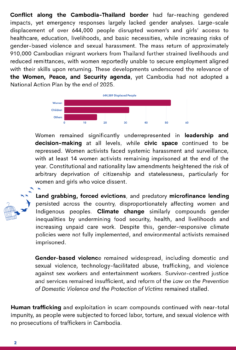
Women remained significantly underrepresented in leadership and decision-making at all levels, while civic space continued to be repressed. Women activists faced systemic harassment and surveillance, with at least 14 women activists remaining imprisoned at the end of the year. Constitutional and nationality law amendments heightened the risk of arbitrary deprivation of citizenship and statelessness, particularly for women and girls who voice dissent.
Land grabbing, forced evictions, and predatory microfinance lending persisted across the country, disproportionately affecting women and Indigenous peoples. Climate change similarly compounds gender inequalities by undermining food security, health, and livelihoods and increasing unpaid care work. Despite this, gender-responsive climate policies were not fully implemented, and environmental activists remained imprisoned.
Gender-based violence remained widespread, including domestic and sexual violence, technology-facilitated abuse, trafficking, and violence against sex workers and entertainment workers. Survivor-centred justice and services remained insufficient, and reform of the Law on the Prevention of Domestic Violence and the Protection of Victims remained stalled.
Human trafficking and exploitation in scam compounds continued with near-total impunity, as people were subjected to forced labor, torture, and sexual violence with no prosecutions of traffickers in Cambodia.
Economic insecurity and labor rights violations persisted for many women, while informal workers faced arbitrary exclusion from social protection mechanisms. Sex workers and entertainment workers continued to lack labor rights protections, underscoring the need for sex work to be decriminalized.
Access to health services remained uneven. Sexual and reproductive health services, including safe abortion, were constrained by stigma and limited awareness, while comprehensive sexuality education was inconsistently implemented.
Cambodia’s prison overcrowding crisis deepened, with a 26% increase in the number of women and girls in detention. Most were held in pre-trial detention under inadequate conditions.
Despite Cambodia’s numerous gender-related policies and strategies, implementation remained limited, uneven, and under-resourced. The Ministry of Women’s Affairs remained among the lowest-funded ministries, receiving 51,979 million riel (about US $12.99 million) – equivalent to about 0.14% of the national budget – while gender mainstreaming across other ministries lacked consistent resources and accountability. [2]
Alongside these challenges, civil society and women’s rights movements faced unprecedented funding cuts by international development actors. The abrupt termination of US foreign aid from January 2025 left many in a survival crisis. Sustainable funding for feminist and women’s rights movements is critical in 2026.
Amid a rapidly shifting national and global context, meaningful progress towards gender equality in Cambodia depends on the government implementing urgent, sustained, and well-resourced reforms that center the voices, priorities, and lived realities of women, girls, and non-binary people to ensure the full enjoyment of their human rights.
Detailed recommendations are available in the report. The following priority actions are recommended to the Cambodian government:
- Resource allocation: Allocate sufficient, dedicated, and long-term human, technical, and financial resources from the national budget to effectively implement Cambodia’s gender equity policies.
- Gender-based violence protection and prevention: Urgently and comprehensively overhaul the legal framework – especially the Law on the Prevention of Domestic Violence and the Protection of Victims; strengthen gender-based violence prevention programs and ensure comprehensive access to services; and decriminalize sex work and repeal all punitive and discriminatory laws.
- Women human rights defenders and civic space: End harassment, violence, and intimidation against women political opponents, journalists, land, labor and environmental activists, women human rights defenders, and independent media outlets.
- Women’s political participation: Ensure women’s equal representation in politics and law-making at the national, provincial, district, and commune levels through temporary special measures. These should include targeted positive action, quota systems, and amendments to electoral laws to require gender-balanced party lists, including mandatory alternation of women and men candidates and women in first-ranked positions for at least 50% of each party’s lists.
- Gender-responsive crisis response: Systematically identify and address the needs of women, girls, and non-binary people in situations of crisis and displacement, including those arising from conflict, migration, climate change, and economic shocks. Ensure access to targeted emergency assistance, essential services, relevant employment and livelihood opportunities, effective gender-based violence protection mechanisms, and sustained debt relief.
PDF: Download full report in English, Download full report in Khmer
PDF: Summary of the report in English, Summary of the report in Khmer
[1] CEDAW Committee, “Concluding observations on the sixth periodic report of Cambodia”, CEDAW/C/KHM/CO/6, November 12, 2019, para. 15(b), online: <https://docs.un.org/en/CEDAW/C/KHM/CO/6>.
[2] Ministry of Economy and Finance, “Budget in Brief: Fiscal Year 2025”, online: https://mef.gov.kh/documents/budget-
in-brief-2025/.