

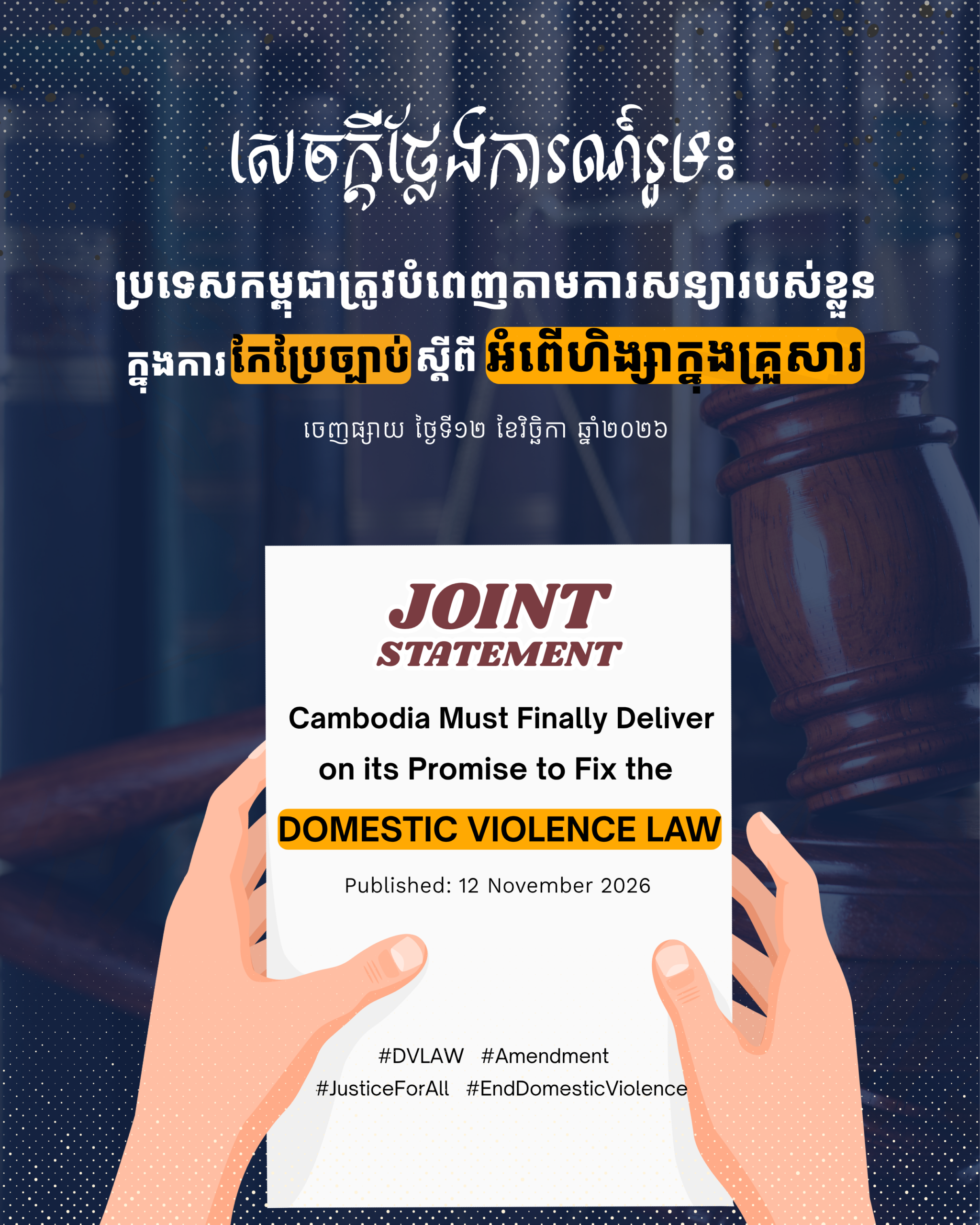
Published: 12 November 2026
This statement discusses domestic violence. If you are experiencing domestic or sexual violence, you can contact an organisation for support.
Cambodia’s 2005 Law on the Prevention of Domestic Violence and the Protection of Victims has been in need of an urgent overhaul for many years. The government’s ongoing failure to do so leaves women, children, and LGBTQI+ people across the country exposed to harm without adequate protections.
In recent years, the Cambodian government, with the support of international development partners, has postured progress towards amending the law by commissioning legal analyses, guidelines, and developing a roadmap that has not been made public several years on. To date, none of these actions has fixed the failures embedded in the Domestic Violence Law, and the lack of consultation with relevant civil society organisations on the proposed amendment process has not instilled confidence that these failures will be meaningfully addressed.
Domestic violence traps women and children in unsafe homes, derails work and education, and causes lasting physical and psychological harm. The Cambodian League for the Promotion and Defense of Human Rights (LICADHO) alone has documented at least 181 people killed in domestic violence cases since 2020, including 24 women, six girls, and five boys killed from just September 2025 to September 2026. Many had sought help before their deaths, only for some authorities to offer to “educate” perpetrators and reconcile couples. None of them were provided with adequate prevention measures or protections, and many others continue to live at risk of harm.
Drafting an amended law is currently planned under the ‘Strengthening Country Systems for Prevention and Response to Gender-Based Violence’ project. The project, implemented by the Cambodian government with funding from the Asian Development Bank, is expected to begin activities next year. People who have been affected by domestic violence and civil society organisations must be included in its planned ‘Multi-Sectoral Working Group’, to ensure the amended law addresses the needs of all people at-risk of domestic violence, effectively holds perpetrators to account, and prohibits all forms of mediation and alternative dispute resolution, given the unequal power dynamics present in these forms of abuse.
The Cambodian government first signalled its intent to amend the Domestic Violence Law over a decade ago. The National Action Plan to Prevent Violence against Women 2014-2018 (NAPVAW II) aimed to review and update some articles of the law. Similar commitments appear in the country’s National Action Plans to Prevent and Respond to Violence Against Children (2017-2021 and 2025-2030), NAPVAW III (2019-2023), and Neary Rattanak VI (2024-2028). NAPVAW IV (2025-2030) again recently set out the government’s intent to amend and publish the amended Domestic Violence Law in line with national and international standards, yet with a concerning timeframe stretching to 2030.
These gaps have been highlighted on multiple occasions. As early as 2015, civil society groups said that the limitations of the law were apparent and called for its amendment. In a statement last year, civil society again said that overhauling the law is an essential step towards addressing this crisis. Every year of delay causes scores of Cambodians’ lives to be ruined or lost.
We again call on the Cambodian government to urgently enact a Domestic Violence Law fully aligned with international human rights standards, and meaningfully include those affected by domestic violence and civil society in every stage of the process, to ensure every Cambodian can live free from violence.
The law’s current key weaknesses, which must be remedied in any amendment, include:
- A failure to comprehensively include all people at risk of domestic violence within the scope of the law.
- A failure to define, criminalise, and outline penalties for physical, sexual, emotional/psychological, and economic abuse, which leaves the law open to subjective interpretation and enables impunity.
- Implicit endorsement of violence as a means of “disciplining” spouses, children, and dependents (Article 8), an entitlement also granted to parents in the Civil Code (Article 1045).
- Tolerance of “minor” acts of violence; the law outlines that felonies and “severe” misdemeanours should be subject to criminal proceedings (Article 19), yet there is no definition of a “severe” misdemeanour in Cambodian law, allowing authorities not to prosecute domestic violence they perceive as “minor”.
- Encouragement of education, reconciliation, and mediation in cases involving emotional/psychological violence, economic violence, and “minor” criminal domestic violence cases (Articles 13, 17, 26-27). Alternative dispute resolution should be prohibited as a response to all acts of criminal domestic violence.
- A failure to comprehensively define the specific obligations of various authorities to prevent and respond to domestic violence.
- A failure to sufficiently define detailed procedures and protections that must be granted under protection orders and administrative decisions.
- A failure to mandate specific funding from the National Budget for the law’s implementation, prevention efforts, and support services.
For more information, please contact:
- Mao Map, Executive Director, Klahaan Organization, Tel: 855 78 974 040
- Oy Mariny, Program Officer, Women Peace Makers (WPM), Tel: 855 86 860 433
- Chim Channeang, Secretary General, NGO-CEDAW, Tel: 855 12 668 853
- Seng Reasey, Executive Director, SILAKA Cambodia, Tel: 855 17 933 336
- RIMPHAT BOPHAPHOUNG, Advocacy and Networking Program Manager, GADC, Tel: 855 69 600 257
Members of the CSO working group proposing amendments to the Domestic Violence Law include:
- Banteay Srei
- The Cambodian NGO Committee on CEDAW (NGO-CEDAW)
- Child Rights Coalition Cambodia (CRC-Cambodia)
- Gender and Development for Cambodia (GADC)
- Klahaan Organization
- World Vision Cambodia
- Cambodian Health and Education for Community (CHEC)
- Women Peace Makers (WPM)
- Plan International Cambodia
- Cambodian League for the Promotion and Defense of Human Rights (LICADHO)
- Cambodia Association to Support Vulnerable Women (ASVW)
- Rural Aid Organization (RAO)
- Cambodian Organization for Women Support (COWS)
- Environment and Health Education (EHE)
- Silaka Cambodia
- Cambodian Labour Confederation (CLC)
PDF: Download full statement in English, Download full full statement in Khmer