

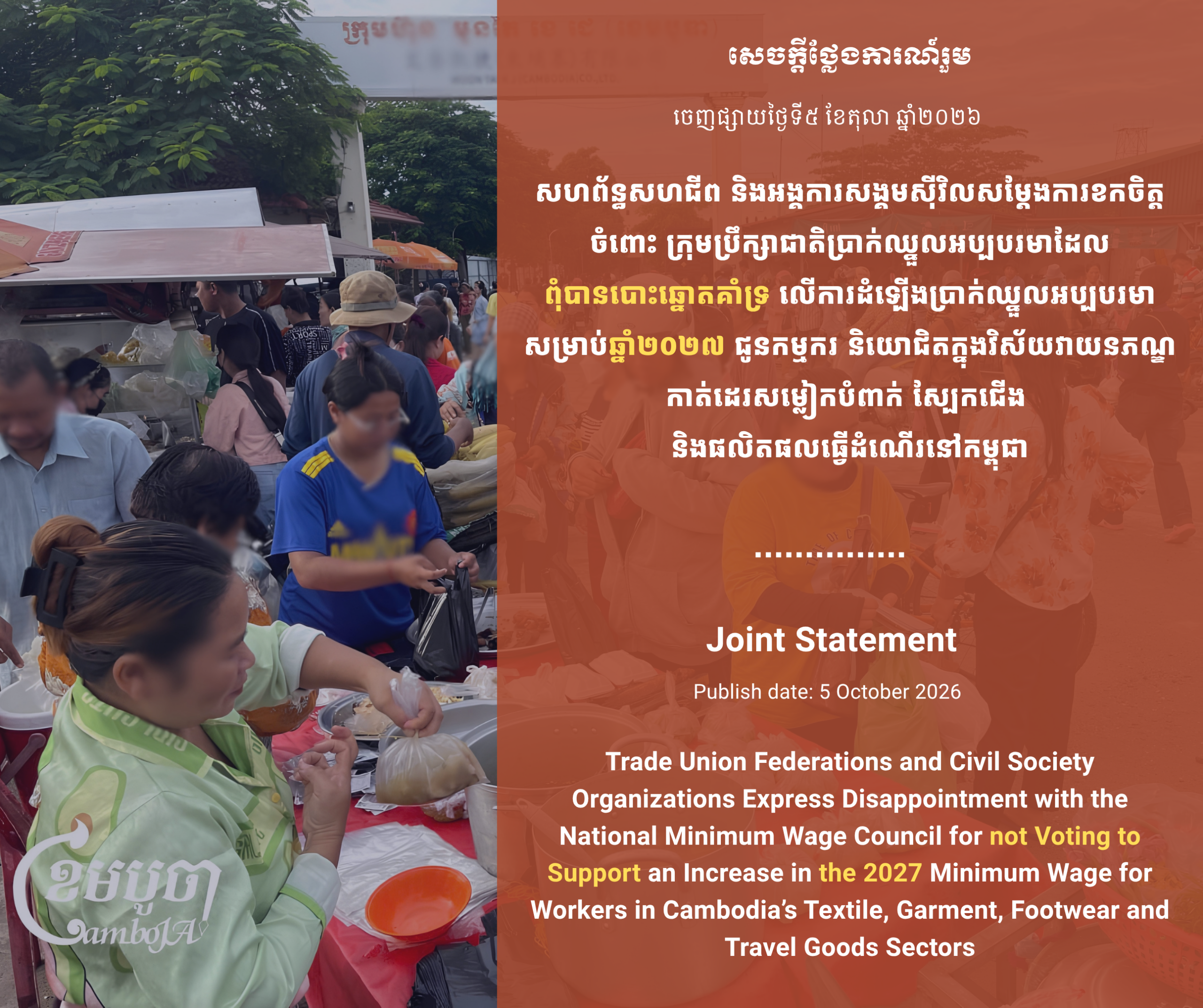
Published on 05 October 2026
We, the undersigned trade union federations and civil society organizations, express our disappointment with the outcome of the internal vote during the final meeting of the National Minimum Wage Council held on 30 September; in which an overwhelming majority of the members voted to maintain the minimum wage at USD 210 rather than supporting an increase in the 2027 minimum wage for workers in garment textile, footwears and travel good sectors. Whereas, an increase of USD 2 over the current USD 210, was made following an intervention by the Prime Minister, which resulted in the minimum wage being increased by US$2. The overwhelming majority of members voted in favor of and to maintain the figure of USD 210, followed by the immediate issuance of a decision on the same day announcing USD 210per month as the minimum wage for 2027. This has raised questions about the independence, transparency, integrity, and effectiveness of the National Minimum Wage Council in carrying out its mandate.
This USD 2 increase falls significantly short of the proposal submitted by the trade union federations in their letter dated 14 September 2026 to the Minister of Labour and Vocational Training and Chair of the National Minimum Wage Council, requesting that the minimum wage be raised to USD 250.66 – a USD 40.66 increase over the current USD 210. The trade union federations’ proposal to raise the minimum wage to USD 250.66 received broad support from more than 100 trade union federations and civil society organizations through a joint statement, as well as from international organizations, including the Asia Floor Wage Alliance and the Clean Clothes Campaign.
We deeply regret that the trade union federations’ proposal to raise the minimum wage to USD 250.66 did not receive the thorough consideration it deserved. The proposal was not arbitrary: it was developed based on the findings of joint research conducted by eight major trade union federations into the actual living expenses of workers and their families. The survey involved 422 workers from 28 factories in Phnom Penh, Kandal and Kampong Speu provinces.
Minimum wage increases over the past seven consecutive years (2018–2027), have consistently remained below the rate of inflation, meaning workers’ real wages have been continuously eroded. The wage increase for 2027 continues and deepens this trend. The USD 2 increase amounts to a mere 0.95% increase in the minimum wage, while the International Monetary Fund (IMF) projects inflation at approximately 3.1% for the same period. In practical terms, an increase of at least USD 6.51 would be required merely to preserve workers’ purchasing power against rising market prices. The USD 2 increase therefore fails to achieve the most basic benchmark – it is not a raise, but a real-terms wage cut.
This reality directly undermines the interpretations and arguments frequently advanced by certain individuals and groups who contend that minimum wage adjustments must satisfy all seven criteria including “inflation,” as stipulated under the Law on Minimum Wage. If the minimum wage cannot even keep pace with the cost of living, the adjustment process has departed from the very purpose the law intends it to serve: protecting workers and their families from falling behind.
Given continued rises in market prices and the cost of living, an increase of only USD 2 will not be sufficient to ease the financial burden on workers and their families but will instead place additional pressure on them as the cost of living continues to rise or to bring about meaningful improvements in their living conditions based on the IMF’s inflation projection. On the contrary, workers may continue to face hardship, as their wages remain too low to cover their actual living expenses in particular, the prices of goods in the market have continued to increase steadily from 2018 to the present while they continue to bear the ongoing burden of debt.
To ensure a decent standard of living and reduce poverty, workers must receive a decent wage that enables them to live with dignity as human beings.
Garment workers are a core part of Cambodia’s workforce and make vital contributions to Cambodia’s economic development. We therefore call on the National Minimum Wage Council and all relevant stakeholders to reconsider the trade union federation’s proposal for a minimum wage increase of USD 250.66 as it constitutes important evidence reflecting the actual living condition and expenses of workers and their families.
An adequate wage is not merely an economic variable – it is the foundation upon which financial security, families’ well-being and social stability rest. Workers who earn enough to live are workers who sustain businesses, communities, and the national economy. We must move beyond survival wages toward a wage that allows Cambodian workers and their families to live with genuine dignity and security.
For further information, please contact:
Mrs. Yang Sophorn, President of the Cambodian Alliance of Trade Unions (CATU)
Tel: +855 (0) 12 880 039
Mr. Khun Tharo, Program Manager, Center for Alliance of Labor and Human Rights (CENTRAL)
Tel: +855 (0) 93 556 671
This joint statement is endorsed by:
-
Centre for Labor and Human Rights Alliances (CENTRAL)
-
Center for Business and Law Organizations (BHRE Center)
-
Asian Floor Wage Alliance (AFWA)
-
Independent Democracy of Informal Economy Association (IDEA)
-
Cambodia Tourism Workers’ Union Federation (CTWUF)
-
Cambodian Federation of Food and Service Workers’ Unions (CFSWF)
-
Cambodian Confederation of Trade Unions (CATU)
-
Labor Rights Supported Union of Khmer Employees of Naga world (LRSU)
-
Cambodian Center for Human Rights (CCHR)
-
Cambodian Human Rights and Development Association (ADHOC)
-
Cambodian League for the Promotion and Defense of Human Rights (LICADHO)
-
Youth Resource Development Program (YRDP)
-
Cambodia Youth Network (CYN)
-
Partnership For Environment and Development (PED)
-
Rural Women’s Association for the Environment (RWAA)
-
Committee for Free and Fair Elections in Cambodia (COMFREL)
-
Coalition for Integrity and Social Accountability (CISA)
-
Independent Trade Union Federation (INTUFE)
-
Federation Union of Labor Incenses (FULI)
-
Cambodia Independent Trade Union Federation (CITUFED)
-
Cambodian Youth Power Union Federation (CYPUF)
-
Workers’ Heart Union Federation (WHUF)
-
Coalition of Cambodian Apparel Workers’ Democratic Union (CCAWDU)
- Federation of Free Trade Union of Workers of the Kingdom of Cambodia (FTUWKC)
-
Cambodian Labour Confederation (CLC)
-
HomeNet Cambodia (HNC)
-
Clean Clothes Campaign (CCC)
-
Cambodia Indigenous Peoples Organization (CIPO)
-
The Cambodian NGO Committee on CEDAW (NGO-CEDAW)
-
Gender and Development for Cambodia (GADC)
-
Building Community Voices (BCV)
-
Klahaan Organization (Klahaan)
-
Environment and Health Education Organization (EHE)
-
Federation of Indonesia Metalworkers Union (FSPMI)
-
Association to Support Vulnerable Women (ASVW)
-
Cambodian Organization for Women Support (COWS)
-
Mondulkiri Indigenous People’s Association for Development (MIPAD)
-
The Cambodian Women’s Development Association (CWDA)
-
Cambodian Health and Education for Community (CHEC)
-
Peoples Training and Research Centre, India
-
Institute for Occupational Health and Safety Development, Philippines
-
Center for Public Health and Environmental Development, Kathmandu, Nepal (CEPHED)
-
Asia Monitor Resource Centre, South Korea
-
Cambodia Tourism Service Workers Federation (CTSWF)
-
Cambodia Industrial Workers Federation (CIWF)
-
Coalition Of Apparel and Industrial Union (C-AI)
-
Khmer Association of Informal Economic (KAI)
-
Farmer Association for Peace and Development (FAPD)
-
Cambodia Truck Drivers Association (CTDA)
- Samakum Teang Tnaot (STT)
-
Equitable Cambodia (EC)
-
197 Land Community (Koh Kong)
-
Bos Snor Communiy (Tboung Khmum)
-
Dak Por Community (Kampong Speu)
-
Klaing Toek 78 Community (Siem Reap)
-
Kuy Indigenous Community (Preah Vihear)
-
Kuy Indigenous in Boh village (Preah Vihear)
-
Kuy Indigenous Community in Ngan commune (Kampong Thom)
-
Land Community (Pailin)
-
Mean Chey Land Community (Svay Rieng)
-
Nature Protection Oudom Sre Pors Community (Kampong Speu)
-
Ou Bat Moan Community (Oddar Meanchey)
-
Phnom Krom Community (Siem Reap)
-
Pongrok Chey Leak community (Kampot)
-
Rattanak Rokha Forestry Community (Oddar Meanchey)
-
Samaki Sangkae Pir Mean Rith (Preah Vihear)
-
Samaki Chek Meas Community (Svay Rieng)
-
Srae Prang Community (Tboung Khmum)
-
Sre Ampel Water Fall Tourism Forestry Community (Kampong Chhnang)
-
Stueng Khsach Sa Forestry Resource (Kampong Chhnang)
-
Tonlung Community (Tboung Khmum)
-
Trapeang Chour Community (Kampong Speu)
PDF: Download full statement in English, Download full full statement in Khmer